Skip to contentFast local sewer line helpSpeak with a local pro today
Sewer Repair vs. Replacement
The choice between repairing and replacing a sewer line comes down to one question: is the damage isolated, or has the whole pipe failed? A repair fixes a defined problem in a sound pipe. Replacement is for a line broken in several places or too deteriorated to hold a patch.
Both choices can be the right one. The mistake is picking before the pipe is seen. Get the line inspected, find out whether the trouble is one spot or the whole run, and the decision usually makes itself.
Repair, rehabilitation, and replacement explained
Spot repair
Fixes a single defined defect, such as one cracked or offset joint, in a pipe that is otherwise in good shape.
Trenchless rehabilitation
Lining or bursting renews the line with little digging, a middle path when the pipe is failing but the route is intact.
Full replacement
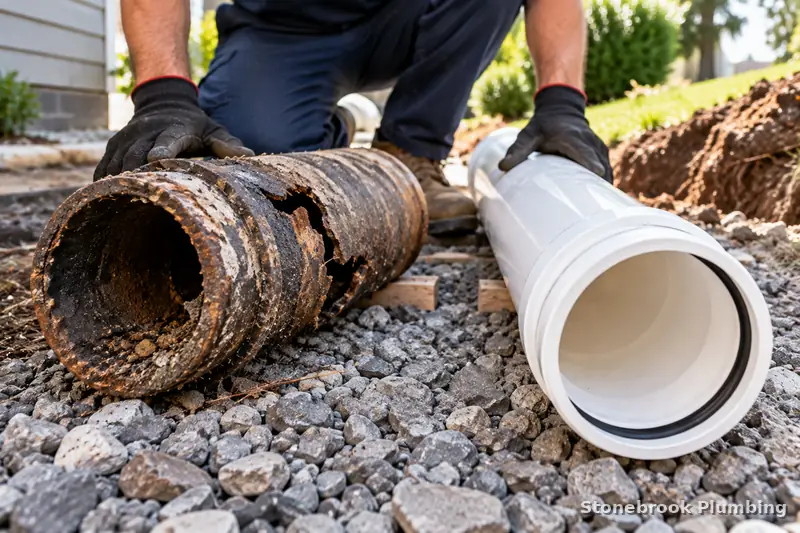
Installs a new lateral when the pipe is collapsed, broken in multiple places, or too far gone to patch reliably.
| Option | What it addresses | When it fits | Yard impact |
|---|
| Spot repair | One isolated defect | Sound pipe, single problem | Localized dig or none |
| Rehabilitation | Cracks, roots, corrosion along a run | Pipe failing but route intact | Low, trenchless |
| Full replacement | A pipe that has failed as a whole | Collapse, multiple breaks, deterioration | Higher, depends on method |
How to tell which one your line needs
Signs a repair is enough
- One isolated problem on the camera
- The rest of the pipe looks sound
- No history of repeat backups
- Good material and slope elsewhere
Signs replacement is the smarter call
- Damage that repeats along the line
- A collapsed or badly sagging section
- Backups that keep returning after repairs
- Old clay or cast iron breaking down throughout
The one thing both decisions depend on
A camera inspection is what separates a spot repair from a replacement. It shows whether the damage is one place or many, marks the location, and ties the recommendation to something you can see. Any decision made without it is a guess. Read how a camera inspection works.
Cost and disruption: how the two compare
Repair
Lower cost and less disruption now. The risk is paying again if the underlying pipe is on its way out.
Replacement
More up front and more disruption, but it resets the whole line for decades. On a failing pipe, it is often cheaper over time. See what drives the cost.
Repair-vs-replacement checklist
Work through this before you commit to either path.
Related sewer line guides
Keep reading, or call and get a local pro on it.
The hidden cost of the wrong call
Real numbers on what a failing sewer line costs in health, money, and disruption.
01Repeated repairs add up
USDA Forest Service research finds roots cause more than half of all sewer blockages and that clearing them early runs about one-sixth of replacing a root-damaged pipe. If the same spot keeps failing, repeated clearings can cost more over time than sealing or replacing the section.
02A full failure is expensive
The Insurance Information Institute puts the average water damage and freezing claim near $12,514. Choosing a cheap patch on a pipe that has really failed can lead straight to that kind of loss.
03How to weigh it
The right call ties the cost to what the camera shows: an isolated defect points to a repair, widespread damage points to replacement. Matching the fix to the evidence is what keeps the total down.
Repair vs. replacement questions homeowners ask
Is it cheaper to repair or replace a sewer line?
A repair usually costs less up front. But repeated repairs on a pipe that is failing along its length can add up to more than a single replacement. A camera inspection is what tells you which situation you are in.
Can you repair just one section of a sewer line?
Yes, when the rest of the pipe is sound. A spot repair or a short liner can address an isolated defect without touching the whole run.
When is replacement worth it over repair?
When the line is collapsed, broken in several places, sagging, or so deteriorated that a patch will not hold. Repeated backups after repairs are a strong sign the pipe itself has failed.
How do I know if my whole line is bad or just one spot?
Only a camera inspection run the length of the lateral can tell you. It shows whether the damage is isolated or repeats along the pipe.
Does trenchless count as a repair or a replacement?
It can be either. Lining rehabilitates an existing pipe, closer to a repair or renewal; pipe bursting replaces the line entirely, both with little digging.
How long will a repair last compared to a replacement?
A sound repair on good pipe lasts for years. A full replacement resets the entire line, with modern pipe commonly rated for 50 years or more.
Who decides, me or the contractor?
The contractor recommends based on the footage; you decide. Ask for the recording so the recommendation is something you can see for yourself.
Should I get a professional opinion before deciding to repair or replace?
Yes. A local pro can camera the line and tell you whether the damage is isolated or widespread, which decides the call. Call 855-816-3796 to get an experienced contractor to inspect it.
Sewer Problem Checker
Tick what you are seeing and get an instant read on what it could be and who to call. This is a guide, not a diagnosis.
Not sure whether to repair or replace?
Get a local contractor to inspect the line and show you which one your pipe actually needs. Call to set it up.